
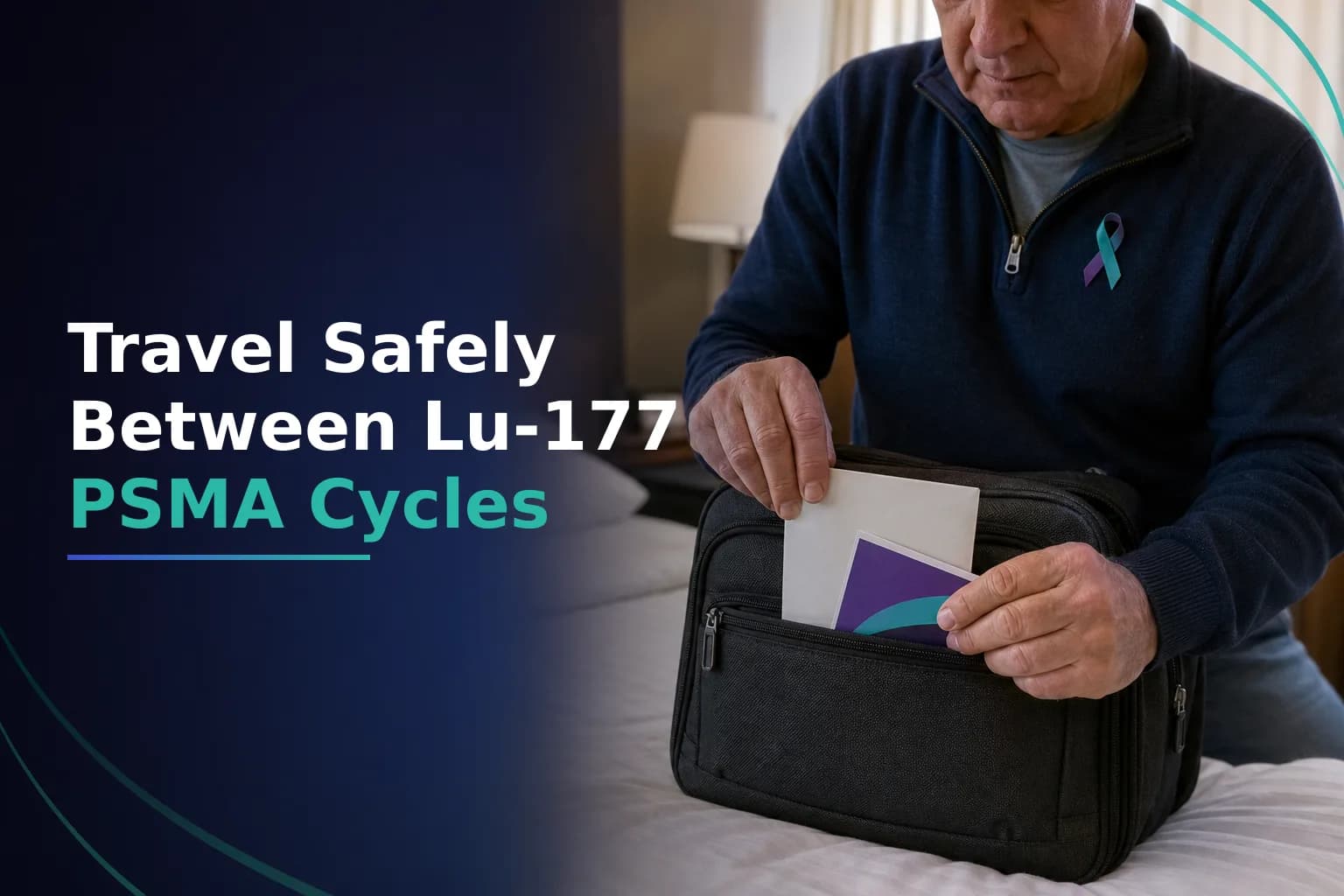
This article is for men with metastatic castration-resistant prostate cancer (mCRPC) who are receiving or considering lutetium Lu-177 vipivotide tetraxetan (often called Lu-177 PSMA). If you are traveling to India for treatment and wondering whether you can fly home between treatment cycles or should stay, this guide explains what you need to know.
The short answer: most international patients can travel between cycles. The treatment happens every six weeks, which gives you roughly five weeks between leaving the hospital and your next appointment. There are specific radiation safety rules for the first several days after each infusion, and you must carry the right paperwork at every airport. If you follow these steps correctly, traveling home between cycles works for most people.
Five things to manage between each Lu-177 PSMA cycle
- Follow radiation safety precautions for at least seven days after each infusion
- Wait five to seven days, confirmed with your nuclear medicine team, before boarding a long-haul flight
- Carry your patient letter and radiation safety card at every airport for three months after your final cycle
- Arrange blood tests at a laboratory near your home and share the results with your India care team
- Decide early whether to stay in India or fly home between cycles, and plan accommodation and return travel accordingly
What does the treatment schedule look like?
The VISION trial, which was the key study supporting FDA approval of lutetium Lu-177 vipivotide tetraxetan, established a standard schedule: 7.4 GBq given every six weeks for up to six cycles. Doctors use that schedule today.
Each cycle is a single intravenous infusion that takes a few hours. Hospital staff monitor you briefly and then discharge you, usually the same day. Your next appointment is six weeks later, giving you roughly five weeks in between. That's what this guide covers.
How fast does radioactivity leave your body?
Lutetium-177 has a physical half-life of about 6.6 days. This means the radioactivity in your body cuts in half every 6.6 days naturally. Your kidneys also clear much of the radioactive material through urine in the first 24 to 48 hours, which is why your urine is most radioactive in those first days.
By three weeks after your infusion, only a small amount of the original radioactivity remains. By six weeks (when your next cycle begins), the previous dose has mostly decayed. This is good news for the later weeks between cycles. The first several days are different, and that's when precautions matter most.
Radiation safety rules for the first seven days
These steps protect your family, fellow travelers, and the public from unnecessary radiation exposure. They come from published best practices for PSMA-targeted radiopharmaceutical therapy and from the joint guideline from the European Association of Nuclear Medicine and the Society of Nuclear Medicine and Molecular Imaging. Your nuclear medicine team will give you written discharge instructions. Always follow those before general guidance.
For more details on radiation safety by day (shared spaces, laundry, returning to normal activities), see our guide to radiation safety after Lu-177 PSMA therapy.
Days one to three:
- Drink plenty of water to help flush radioactive material through urine more quickly
- Flush the toilet twice after each use and wash your hands thoroughly each time
- Avoid public transport journeys longer than one hour on the day of discharge
- Avoid any close contact with pregnant women
- Keep at least one meter away from children under ten years of age
- Sleep in a separate bed for at least three nights
Days four to seven:
- Continue the one-meter distance from young children and pregnant women
- Maintain toilet hygiene - urine remains slightly radioactive through this period
- Most patients can return to desk work or light duties by days two to three
After day seven, normal activities are generally safe for the people around you. Your team may give you different instructions based on your dose and kidney function that cycle.
What happens at airport security after Lu-177 PSMA treatment?
Airport security scanners can detect you. Even days or weeks after your infusion, the low-level residual radioactivity in your body will trigger radiation monitors at international airports and border crossings. This doesn't mean you're dangerous to other passengers. The monitors are just doing their job.
When a detector flags you, security staff will do additional screening. If you don't have paperwork from your hospital, the screening can take a long time and feel stressful, especially if the staff don't know about medical radioactivity.
According to Mayo Clinic, patients who have received lutetium Lu-177 therapy may experience travel delays when residual radioactivity is detected at ports of entry. The fix is simple: carry a patient letter and radiation safety card with you at all times after each cycle.
Your patient letter should include:
- Your full name
- Contact information for your treating hospital
- The name of the radiopharmaceutical: lutetium Lu-177 vipivotide tetraxetan
- The date of your most recent infusion
- The dose administered in gigabecquerels (GBq)
- The physical half-life of lutetium-177 (6.6 days)
- A 24-hour contact number at the treating nuclear medicine unit
The Society of Nuclear Medicine and Molecular Imaging (SNMMI) recommends you carry this documentation for at least three months after your final cycle. Ask your India nuclear medicine team for this letter before you leave the hospital. Also keep a digital copy on your phone as backup.
When in the six-week window is it safe to fly?
Most nuclear medicine teams advise waiting at least three to five days before flying after a Lu-177 PSMA infusion. For long-haul flights over five hours (like flights from India to East Africa, West Africa, the UK, or Australia), many teams recommend waiting five to seven days instead.
Why does flight length matter? On long flights, you sit close to other passengers for many hours. In the first few days after treatment, the radiation dose from your body might exceed international public safety limits for nearby passengers.
By days five to seven, published guidance on PSMA-targeted radiopharmaceutical therapy shows that the dose to fellow travelers stays within accepted public limits.
Here's how it works in practice: A patient treated Monday in Mumbai and flying to Dubai (3-4 hours) can probably fly Thursday or Friday. A patient flying to Lagos or Nairobi (8-9 hours) should wait until the following weekend. Your exact safe-to-fly date depends on your dose and how fast your kidneys clear the radioactive material. Ask your team when you can safely fly before you book your return trip.
Blood tests between cycles: arrange these before you fly home
Between cycles, your care team checks your blood counts and kidney function. Lu-177 PSMA therapy can affect bone marrow, and your team will track kidney health throughout the treatment. You need these tests at the right times, but you don't need to do them in India.
Before you fly home after each cycle, get a written blood test order from your India team. Most teams want a full blood count and kidney function markers like creatinine or eGFR, usually at two to four weeks after the infusion. Any accredited lab near your home can do these tests.
Before leaving India, confirm which tests you need, when you need them, how to share results with your India team, and which results need urgent contact versus routine updates.
For details on what your care team monitors between cycles and why, see our guide on monitoring after your Lu-177 PSMA cycles.
Should you stay in India between cycles or fly home?
This is the planning question for international patients like you. There's no single right answer. It depends on where you live, how hard the journey is, your support system, and the cost of each option.
Flight distance and physical recovery
A 3-4 hour flight to the Gulf is much easier than an 8-10 hour flight to East or West Africa, or a 12-14 hour flight from Australia or Europe. Post-treatment fatigue is common in the week after a Lu-177 PSMA infusion. A long flight during that recovery time adds stress to your healing body. If you feel very tired after a cycle, skip a same-week long flight even if radiation rules allow it.
Cost of staying versus flying
Staying in India for the full six weeks means several weeks of accommodation. In cities like Chennai, Hyderabad, or Mumbai, a serviced apartment near the hospital might cost much less than two long-haul return flights. Do the math both ways before you decide.
Family and support
If your spouse or adult child is traveling with you, staying in India for the whole treatment is usually simpler. If your carer needs to go home for work or family, flying back between cycles might be necessary.
Medical cover at home
If your local hospital can do blood tests, manage side effects, and talk to your India team, following treatment from home works for most patients. If your home country has limited cancer support, staying near your care team helps.
If you want outside input, you can submit your case to the Art of Healing Cancer team. They can help you plan your treatment schedule and decide whether staying or flying between cycles is better for you.
For details on the practical side of your treatment visit (choosing accommodation, coordinating with your India team, what to expect), see our guide to planning your Lu-177 PSMA treatment in India.
Managing fatigue and sleep in the inter-cycle window
Long-haul travel during treatment adds stress that's easy to underestimate. Jet lag, poor sleep, and recovery from the radioligand therapy combine to make you more tired than expected. Adding a rest day before and after a long flight helps. If you want over-the-counter sleep support during travel and recovery, Ayurnomics has a sleep and stress line designed for travel disruption.
Your inter-cycle checklist
Before you leave the hospital after each cycle:
- Collect your radiation safety card and patient letter - confirm it includes all required details
- Confirm the date of your next infusion appointment
- Collect written blood test orders with the required date range
- Get a 24-hour emergency contact number for the nuclear medicine unit
- Ask your team how many days you need to wait before your specific long-haul flight
Days one to three at your accommodation:
- Follow all radiation precautions from your written discharge instructions
- Drink extra water throughout each day
- Double-flush the toilet and wash hands thoroughly after every use
- Maintain one-meter distance from children under ten and avoid pregnant women
Day five to seven onward (for most patients):
- Confirm your safe-to-fly date with the team before booking your flight
- Keep your patient letter and radiation card in your carry-on bag at all times
Weeks two to five at home:
- Complete blood tests by the date your team specified
- Send results to your India care team promptly
- Rest, eat well, and maintain light activity as tolerated
- Book return travel so you arrive at least one day before your next appointment
When to talk to your doctor
Talk to your nuclear medicine team before booking any flights after Lu-177 PSMA treatment. Ask how many days to wait based on your dose and kidney function. Check that your patient letter is current. Ask which blood test results need urgent contact and which are routine. Ask what to do if airport security takes longer than expected.
If you feel unwell, have a fever, lose energy, or have urinary problems in the first week after treatment, contact your care team before traveling.
If you're unsure whether Lu-177 PSMA is right for you or whether India is the right place for treatment, contact the Lutetium Therapy team to discuss your options. If Lu-177 PSMA isn't right for you, they can discuss other treatments.
This article is for general information and is not medical advice. Always talk to your oncologist or care team about your specific situation.
Frequently asked questions
How long after a Lu-177 PSMA infusion can I fly?
Most nuclear medicine teams recommend waiting at least three to five days before a short flight and five to seven days before a long-haul flight of five hours or more. The exact timing depends on your administered dose and how quickly your kidneys cleared the radioactive material in that cycle. Always confirm the safe-to-fly date with your nuclear medicine team before booking any flights after each infusion.
Will I set off airport radiation detectors after Lu-177 PSMA therapy?
Yes, it is possible. The residual radioactivity in your body can trigger sensitive radiation monitors at airports and border crossings for days or even weeks after treatment. This is not dangerous but can cause delays. Carry your radiation safety card and a patient letter from your treating hospital at all times. The letter should state your name, the date of treatment, the name of the radiopharmaceutical, the dose given in GBq, the half-life of lutetium-177, and a 24-hour contact number for the treating nuclear medicine team.
Can I stay in a hotel between Lu-177 PSMA cycles rather than remain in hospital?
Yes. Most patients are discharged the same day as their infusion and stay in nearby accommodation for the remainder of their visit. You do not need to remain in hospital between cycles. In the first few days you need to follow radiation precautions in your accommodation - including toilet hygiene and maintaining distance from children and pregnant women - but most hotel rooms or serviced apartments are suitable.
What blood tests do I need between Lu-177 PSMA cycles, and can I have them done at home?
Yes, most blood tests between cycles can be done at your local hospital or clinic. Your care team will typically ask for a full blood count and kidney function tests, usually around two to four weeks after the infusion. Collect the blood test order before you leave India after each cycle and confirm how to send the results to your India team. Ask what results would require you to contact them urgently.
Is it better to stay in India between Lu-177 PSMA cycles or fly home each time?
It depends on your flight distance, cost, and support situation. Patients from the Gulf, where flights to India are 3-4 hours, often find it practical to fly home between cycles. Patients traveling from East Africa, West Africa, Australia, or Europe may find that repeated long-haul flights are too physically demanding and that the cost of staying in India is lower than expected once accommodation and flight costs are compared. A teleconsultation with your India care team before the course begins can help you plan the right approach for your situation.
How many cycles of Lu-177 PSMA therapy are there in total?
The VISION trial used up to six cycles given every six weeks. In clinical practice the number varies. Some patients complete four cycles; others receive six. The decision depends on how well you are tolerating treatment and how your tumor markers and imaging respond. Your oncologist and nuclear medicine team will review your response after each cycle and advise on whether to continue.